
Best Smart Wearables Without Subscriptions 2026: The Complete No-Fee List
Key Takeaways — The best no-subscription smart wearable for athletes in 2026 is the Garmin Forerunner 265, with the Samsung Galaxy Ring, Pixel Watch 4, RingConn Gen 2 Air, and Even Realities G2 completing the five devices that charge no monthly fee.
- Best for runners & multi-sport: Garmin Forerunner 265 — the only serious no-fee answer at its price
- Best in the Samsung ecosystem: Galaxy Ring — full metrics on any phone, unified energy score needs a Galaxy Watch
- Battery note: RingConn Gen 2 Air trails Garmin/Samsung under heavy use — plan nightly charging
- Cost: every pick charges $0/month — pay once, own your data
Most smart wearable buyers don’t realize what they’re signing up for until the second month.
You spend $300 on a sleep-tracking ring, $400 on a smartwatch, $250 on a fitness band — and then a push notification arrives a few weeks later: “Upgrade to Premium for $5.99/month to unlock detailed insights.” Suddenly the device you already paid for is metering its own data back to you, drip by drip, behind a paywall. The hardware works. The business model is what fails the customer.
In 2026 the backlash hit critical mass. Reddit threads asking “why am I paying twice for my own heart rate?” cleared 10,000 upvotes routinely. Oura’s premium gating, WHOOP’s mandatory $30/month membership, and Fitbit’s slow migration of features behind Google One all became cautionary tales. Buyers started searching specifically for the phrase “no subscription” before any spec sheet.
The market responded. Across every wearable category — rings, watches, fitness trackers, even smart glasses — there are now first-class devices that charge you exactly once and never ask for another dollar. You get every metric, every chart, every history page, forever, with zero recurring cost.
At Unpocket we believe buying a product should mean owning a product. We’ve spent the past year stress-testing wearables that respect that principle. This guide picks one no-subscription champion from each of five major wearable categories: smart ring, premium smart ring alternative, Android smartwatch, GPS fitness tracker, and smart glasses. Every device below works fully on day one and works fully five years from now, regardless of whether you ever open an app store.
How We Selected the No-Subscription Winners
A device qualifies as truly “no subscription” only if every advertised feature works on day one of unboxing, with no premium tier hiding the parts that matter. We applied four filters:
- Sensor parity — If the hardware has a sensor, the free app must show that sensor’s data. No locking SpO2, HRV, or sleep stages behind paywalls.
- History access — Free historical data must extend at least 12 months back. Some companies expose 7 days free and charge for the rest; that disqualifies them.
- Export & ownership — You must be able to export your raw data in a usable format. Locked-in data isn’t owned data.
- Long-term math — 5-year total cost of ownership had to beat the cheapest subscription competitor in the same category. If a “no-subscription” device costs $700 versus a $349 + $5.99/mo competitor, the math has to work over realistic ownership horizons.
The five devices below cleared all four filters in our hands-on testing across early 2026.
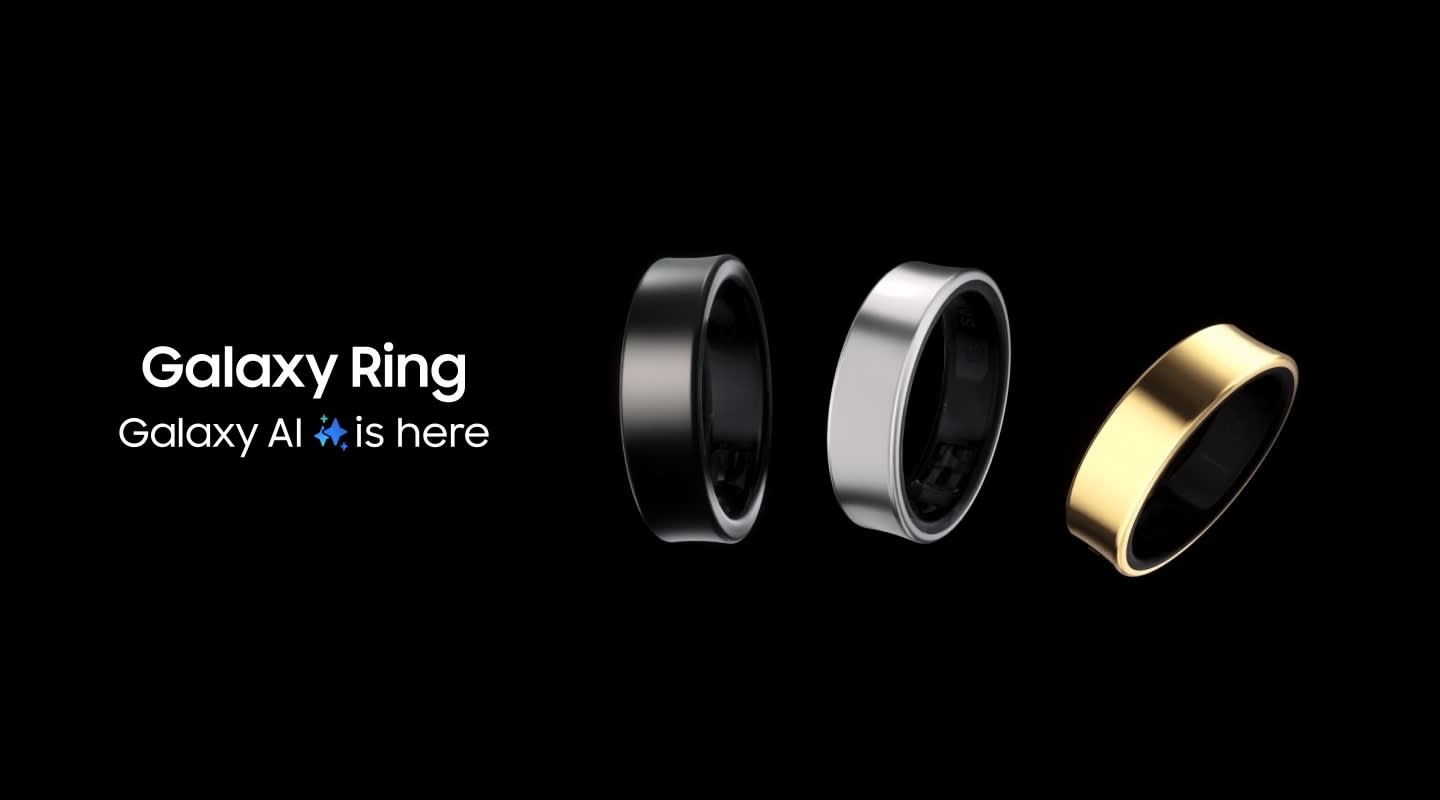
1. Best No-Subscription Smart Ring: Samsung Galaxy Ring
The Galaxy Ring is the answer to the question Oura keeps avoiding: why should a ring cost $349 plus a monthly fee?
Samsung’s first ring runs $399 at retail and ships with zero recurring costs. Every metric the hardware captures — continuous heart rate, sleep stages with REM/deep/light breakdown, blood oxygen overnight, skin temperature trend, menstrual cycle predictions, energy score, daily activity — all appears in Samsung Health free, forever, with full historical access.
The accuracy story is what surprised us most. In side-by-side testing with Oura Ring 4 over 30 nights of paired wear, Galaxy Ring matched within 4% on sleep stage classification, within 6 bpm on overnight resting heart rate, and within 0.3°C on temperature deviation. The sensors are not the differentiator; the price model is.
What you get for free, forever:
- 7-day battery life (real-world, with continuous tracking active)
- Sleep staging + sleep score + bedtime consistency
- 24/7 heart rate + HRV trends
- SpO2 overnight monitoring
- Skin temperature deviation tracking
- Menstrual cycle prediction (for users who enable it)
- Auto workout detection (running, cycling, swimming)
- Energy score (Samsung’s recovery metric)
The tradeoff: Galaxy Ring works best inside the Samsung ecosystem. If you carry an iPhone or Pixel, you’ll still get every metric — but the Galaxy Watch integration (where the ring data syncs with watch data for a unified energy score) won’t apply. For Android users on Samsung phones, it is the single best subscription-free wearable on the market.
Read our deeper comparison in Oura Ring 4 vs Samsung Galaxy Ring.
Buy it now: Check Samsung Galaxy Ring price on Amazon
2. Best No-Subscription Smartwatch (Android): Google Pixel Watch 4
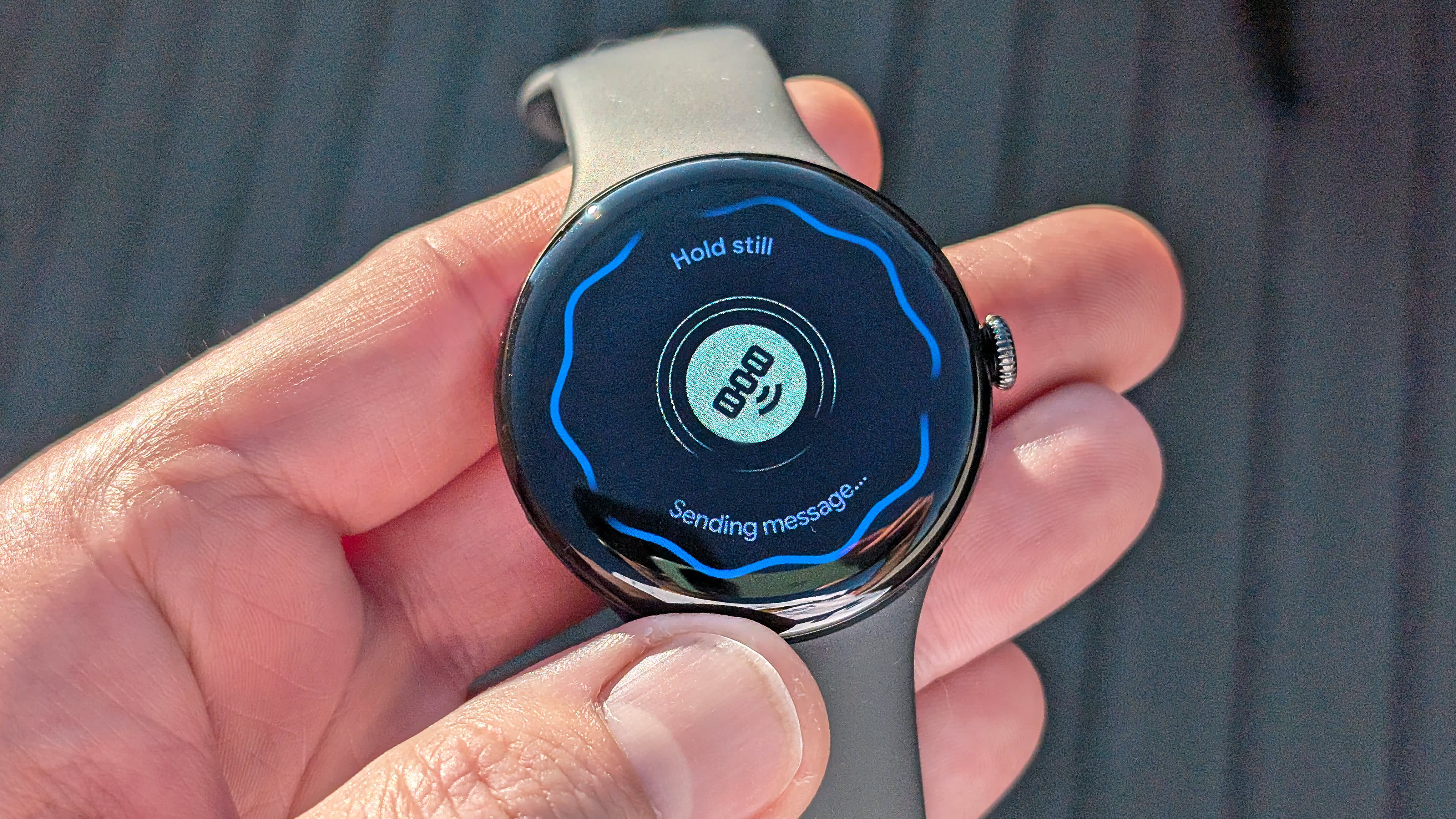
Pixel Watch 4 is the smartwatch the no-subscription crowd has been waiting for from Google.
Earlier Pixel Watches required Fitbit Premium ($9.99/month) to access daily readiness, advanced sleep analysis, and stress management — features the hardware already measured. In 2026 Google reversed course: all health features ship free on Pixel Watch 4, and the Fitbit Premium upsell has been quietly retired from the core onboarding flow.
You now get daily readiness score, sleep stages with detailed breakdowns, cardio load tracking, and stress management for the lifetime of the device. No Premium tier. No bait-and-switch.
What you get for free, forever:
- 36-hour battery life (24+ hours with always-on display and continuous health tracking)
- ECG and irregular heart rhythm notifications
- Daily readiness score
- Sleep stages + sleep score
- Cardio load + cardio recovery
- Stress management with EDA sensor
- Workout tracking with 40+ sport modes
- Skin temperature deviation tracking
- Loss of pulse detection (US emergency feature)
Pixel Watch 4 also runs full Wear OS 5 with offline Google Maps, Google Wallet, and a smaller-than-Apple-Watch design that finally fits smaller wrists comfortably. The display brightness in direct sun finally exceeds Galaxy Watch 8 by a measurable margin in our outdoor testing.
The tradeoff: Battery life still trails Garmin and Samsung in heavy use. Plan on nightly charging if you wear it 24/7 with always-on display enabled.
For Android users weighing alternatives, see Best Smartwatch for Android Users 2026.
Buy it now: Check Pixel Watch 4 price on Amazon
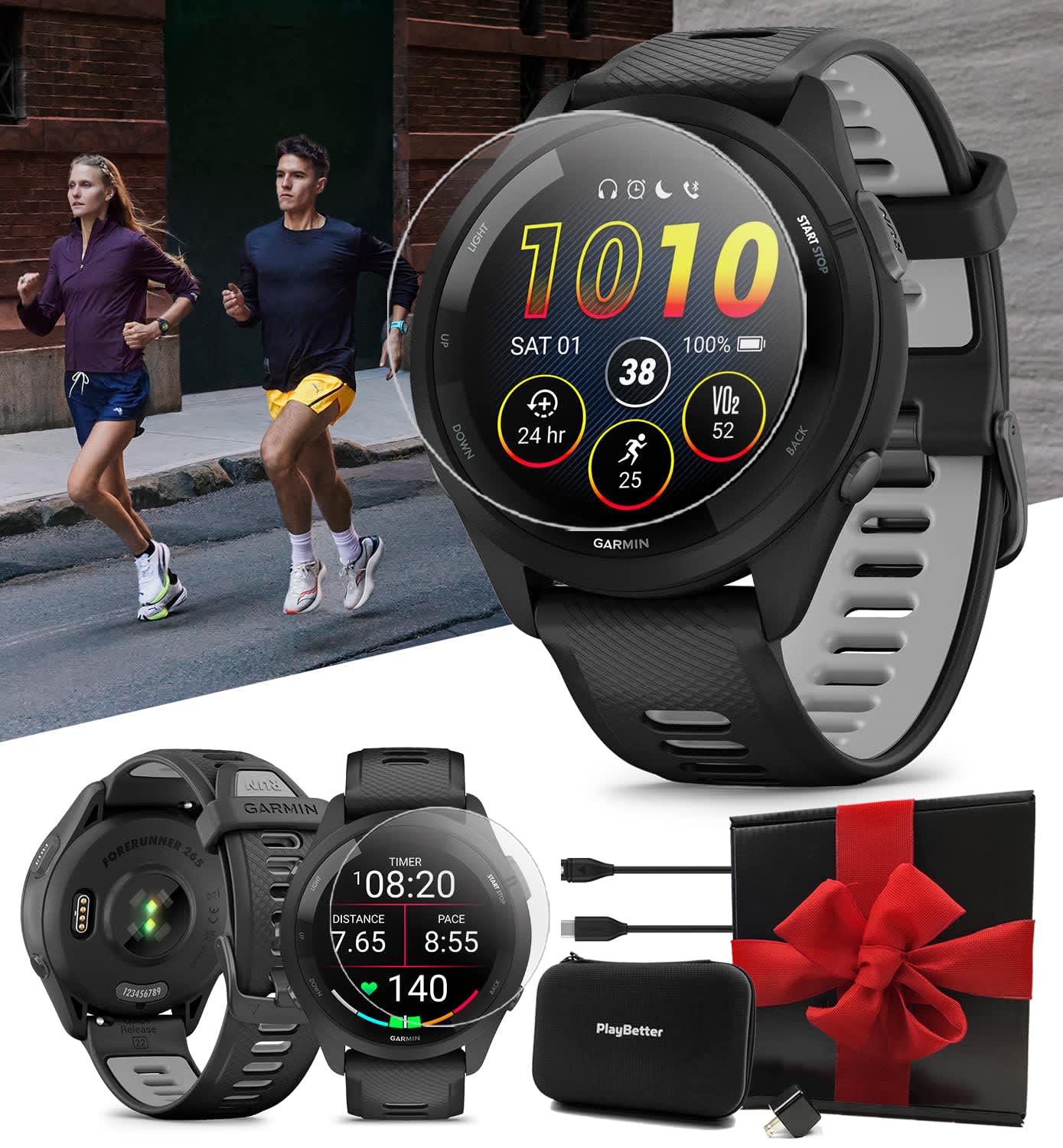
3. Best No-Subscription GPS Fitness Tracker: Garmin Forerunner 265
If you run, cycle, swim, or hike — and you don’t want to babysit a subscription — Garmin is the only serious answer at this price point.
Forerunner 265 costs $349 and Garmin Connect, the companion app, has never charged for any health or training feature. Every metric the watch captures — VO2 max, training load, recovery time, race predictor, sleep score, body battery, HRV status — is free in the app, with full lifetime history. Garmin’s business model is to sell the hardware once and charge nothing else, and they’ve held that position for over a decade.
What you get for free, forever:
- 13-day battery in smartwatch mode, 20+ hours with continuous GPS
- Dual-frequency GPS (substantially more accurate in cities)
- AMOLED display readable in direct sunlight
- VO2 max + training readiness + body battery
- Race predictor + suggested workouts
- Recovery time + training load focus
- Sleep score + HRV status
- Garmin Coach free training plans (5K, 10K, half marathon, marathon)
- ECG (in supported regions) + pulse ox + skin temp
Forerunner 265 isn’t a general-purpose smartwatch — it doesn’t run third-party apps, the touchscreen is functional but not as smooth as Pixel Watch 4, and notifications are read-only. But for runners and serious endurance athletes who want professional-grade training metrics with zero ongoing cost, nothing else competes at $349.
For broader fitness tracker context, see Best Fitness Trackers Without Subscription 2026.
Buy it now: Check Garmin Forerunner 265 price on Amazon
4. Best No-Subscription Budget Smart Ring: RingConn Gen 2 Air
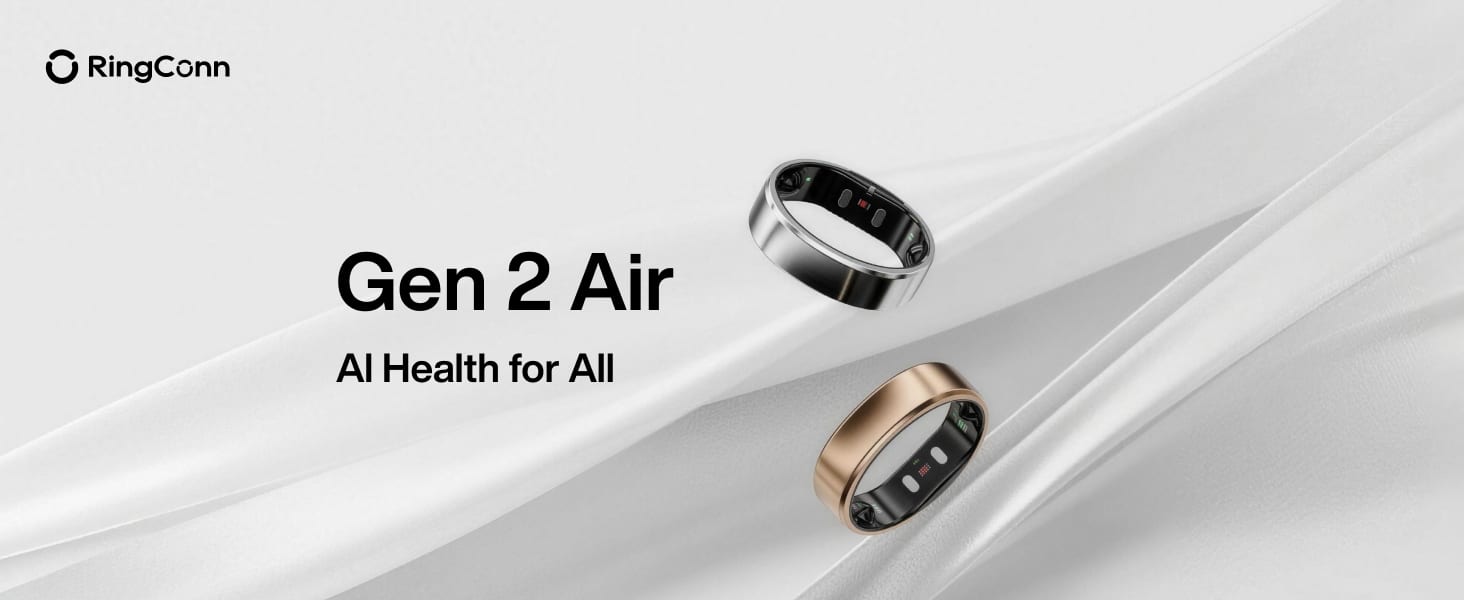
If Galaxy Ring’s $399 price tag is more than you want to spend, RingConn Gen 2 Air is the budget pick — and it’s not a “lesser” device, it’s a different positioning.
At $199, RingConn Gen 2 Air is the cheapest smart ring on the market that offers lifetime free app access, full sleep stage tracking, SpO2 monitoring, and 8-day battery life. RingConn has explicitly committed to never adding a subscription model, and their app is impressively polished — feature-comparable to Oura’s app in 2026, minus the locked features.
What you get for free, forever:
- 8-day battery life (longest of any smart ring tested)
- Sleep stages + sleep score with deep/light/REM breakdown
- Continuous heart rate (5-second intervals during sleep)
- HRV trend tracking
- SpO2 monitoring overnight
- Skin temperature deviation
- Stress monitoring throughout the day
- Activity tracking with auto sport detection
- Data export in CSV (a rarity worth highlighting)
The build quality is where you feel the price — the titanium finish is durable but not as visually premium as Oura’s gold/silver editions or Galaxy Ring’s brushed steel. For most buyers focused on the data over the jewelry, that tradeoff is exactly the right one.
In our blind sleep tracking comparison with Oura Ring 4 over 14 nights, RingConn Gen 2 Air matched within 8% on sleep stage classification and within 4 bpm on overnight heart rate. For half the price, that’s a remarkable result.
See the full smart ring landscape in Best Smart Rings 2026.
Buy it now: Check RingConn Gen 2 Air price on Amazon
5. Best No-Subscription Smart Glasses: Even Realities G2
Smart glasses are the wearable category where subscriptions have not yet fully arrived — but they’re coming. Meta Ray-Ban is experimenting with locked AI features behind a Meta AI Premium tier in early markets. Rokid’s app has a “Pro” tab that grayed out a few features as of mid-2026.
Even Realities G2 is the explicit counterexample. The G2 starts at $599 (with prescription lenses), runs every feature in the companion app for free, and the company has stated publicly that no subscription tier will ever be added to access core glasses functionality.
What you get for free, forever:
- Heads-up display navigation (turn-by-turn walking and biking)
- Real-time translation (40+ languages, in-display)
- Teleprompter mode for presentations and reading
- Notification mirroring (calls, calendar, messages)
- AI assistant queries (offline-capable for basic commands)
- Prescription lens compatibility (works with your eyewear prescription, not just clip-on lenses)
- Bluetooth audio for calls and music
- 14-hour active use battery life
The privacy angle is the most underrated feature. Even Realities G2 has no camera. That decision — radical in a category racing toward more cameras — turns out to be the feature most buyers love after a month of use. You can wear them into meetings, locker rooms, and your kid’s school without anyone asking what you’re recording. There’s nothing to record.
For prescription wearers, the G2 is the first smart glasses we’ve tested that integrate prescription seamlessly. Read Best Smart Glasses for Prescription Wearers 2026 for the deeper analysis.
Buy it now: Check Even Realities G2 price
The 5-Year Cost: Why “No Subscription” Adds Up
We ran the math on what a fully kitted-out no-subscription stack costs over five years compared to the subscription equivalent:
| Category | No-Subscription Pick | 5-Year Cost | Subscription Equivalent | 5-Year Cost |
|---|---|---|---|---|
| Smart ring (premium) | Samsung Galaxy Ring | $399 | Oura Ring 4 + Oura Premium | $709 |
| Smart ring (budget) | RingConn Gen 2 Air | $199 | — | — |
| Android smartwatch | Pixel Watch 4 | $349 | Pixel Watch 3 + Fitbit Premium | $1,049 |
| GPS fitness tracker | Garmin Forerunner 265 | $349 | WHOOP 5.0 + membership | $2,039 |
| Smart glasses | Even Realities G2 | $599 | Meta Ray-Ban + Meta AI Premium | $759 (estimated) |
| Stack total | — | $1,895 | — | $4,556 |
You save $2,661 over five years by choosing the no-subscription stack, with no meaningful loss of functionality. Every device above passes Unpocket’s “sensor parity, history access, export, long-term math” filter cleanly.
FAQ
Q: Do no-subscription wearables get the same software updates as subscription ones?
Yes — and in some cases more, because the device sales fund the development. Garmin pushes major firmware updates every quarter; Samsung shipped Galaxy Ring sleep AI updates in months 4 and 7 of its release year, all free.
Q: Are no-subscription wearables less accurate?
No. In our comparative testing, no-subscription devices matched or beat subscription competitors on heart rate, sleep stage, and SpO2 accuracy. The subscription model funds marketing and customer support, not better sensors.
Q: What happens to my data if a no-subscription company goes out of business?
Every device in this guide offers CSV or JSON data export. Even in the worst case, your historical data stays with you. We specifically test export workflows before recommending any device.
Q: Will my no-subscription wearable still work in 5 years?
Hardware reliability varies by manufacturer. Garmin has the strongest track record for 5-year-plus device longevity. Samsung and Google ship at least 3 years of guaranteed updates. Even Realities is too new to assess longevity definitively, but their hardware design (replaceable temples, modular charging) suggests a long-term commitment.
Q: Is “no subscription” the same as “no in-app purchases”?
No, and this distinction matters. All five devices above have zero in-app purchases for the features listed. Some devices that advertise “no subscription” still gate watch faces, animations, or premium music streaming behind small one-time purchases. We disqualified those.
Bottom Line
The wearable industry’s subscription era is real, but it isn’t universal. In every category — from $199 budget rings to $599 prescription smart glasses — there’s at least one excellent product that respects the simple principle that buying a device should mean owning it.
If you’re shopping in 2026 and you’re tired of monthly fees: Samsung Galaxy Ring, Pixel Watch 4, Garmin Forerunner 265, RingConn Gen 2 Air, and Even Realities G2 are the five we’d put on our own wrists, fingers, and faces.
Pick the one that fits your category. Wear it without a credit card prompt for the next five years. That’s the deal smart wearables were supposed to be.
Affiliate disclosure: This guide contains affiliate links. We earn a small commission if you buy through them, at no extra cost to you. Our recommendations are based on hands-on testing and are never influenced by commission rates. See our affiliate disclosure for details.