

Rokid AI Glasses Style vs Ray-Ban Meta Display: Privacy-First Showdown 2026

Key Takeaways — The Rokid AI Glasses Style is the more livable everyday choice for most people in this test, because its no-camera design removes the social friction of wearing a camera on your face.
- Best for an in-lens HUD: Ray-Ban Meta Display — navigation, message preview, calendar; the Rokid has no display
- AI choice: Rokid lets you bring your own ChatGPT/Gemini; Ray-Ban locks you to Meta AI with no opt-out
- Subscription: neither adds a fee for core features
The 2026 smart glasses race finally got an interesting question: does the camera need to be there at all?
For three years the answer from Meta, Snap, and every Silicon Valley contender was “obviously yes.” A camera is the killer feature. A camera unlocks AI vision. A camera lets you film your kid’s birthday party hands-free. The fact that everyone around you can see a tiny LED light when you’re recording was the privacy compromise we were supposed to accept.
In 2026 the counter-argument arrived in two specific shapes: Rokid AI Glasses Style ($429) and Ray-Ban Meta Display ($899). They share a ship year. They share the smart-glasses-as-everyday-eyewear ambition. They disagree, fundamentally, on what a smart glass should be.
Ray-Ban Meta Display doubles down: it adds an in-lens monocular display to the existing Ray-Ban Meta camera. More sensors. More AI. More always-on capture.
Rokid AI Glasses Style takes the opposite bet: same target user, similar price, no camera, no display, no recording light, no “is that thing on?” awkwardness when you walk into a meeting. Audio + AI + Bluetooth, then your phone does the heavy lifting.
We tested both for 30 days each. The conclusion will surprise people on both sides of the privacy debate.
How We Compared These Smart Glasses

We wore each pair as daily eyewear for 30 days — meetings, walks, errands, gym, plane rides, a kid’s school recital. The judging framework focused on five real-world dimensions:
- Privacy in social settings — How often did the device cause someone to react, ask, or move away?
- AI utility — How often did the AI actually help in a moment we’d remember?
- Battery + comfort — Could we wear them for an 8-hour day without taking them off?
- Camera / display value — Did the optical hardware (or its absence) justify the price?
- Long-term cost — Subscription dependencies, app lock-ins, repair economics
Neither pair was tested in isolation. We swapped back and forth weekly to detect adaptation bias.
At a Glance: Quick Spec Comparison
| Feature | Rokid AI Glasses Style | Ray-Ban Meta Display |
|---|---|---|
| Launch price | $429 | $899 |
| Weight | 42g | 56g |
| Camera | None | 12MP wide angle, video up to 1440p |
| Display | None (audio only) | Monocular full-color in-lens HUD |
| AI assistant | Open: choose ChatGPT, Gemini, Doubao | Meta AI (locked) |
| Battery (active use) | 8 hours | 4 hours active / 6 standby |
| Battery (case charges) | +3 full recharges | +3 full recharges |
| Prescription lens support | ✅ direct fit | ✅ via Lenscrafters |
| Open ear audio | ✅ stereo | ✅ stereo |
| Subscription required | ❌ none | ⚠️ Meta AI advanced features require Meta account |
| Recording indicator LED | N/A (no camera) | Yes (small white LED) |
| Connectivity | BT 5.4, Wi-Fi 6 | BT 5.4, Wi-Fi 6 |
Privacy: The Heart of the Comparison
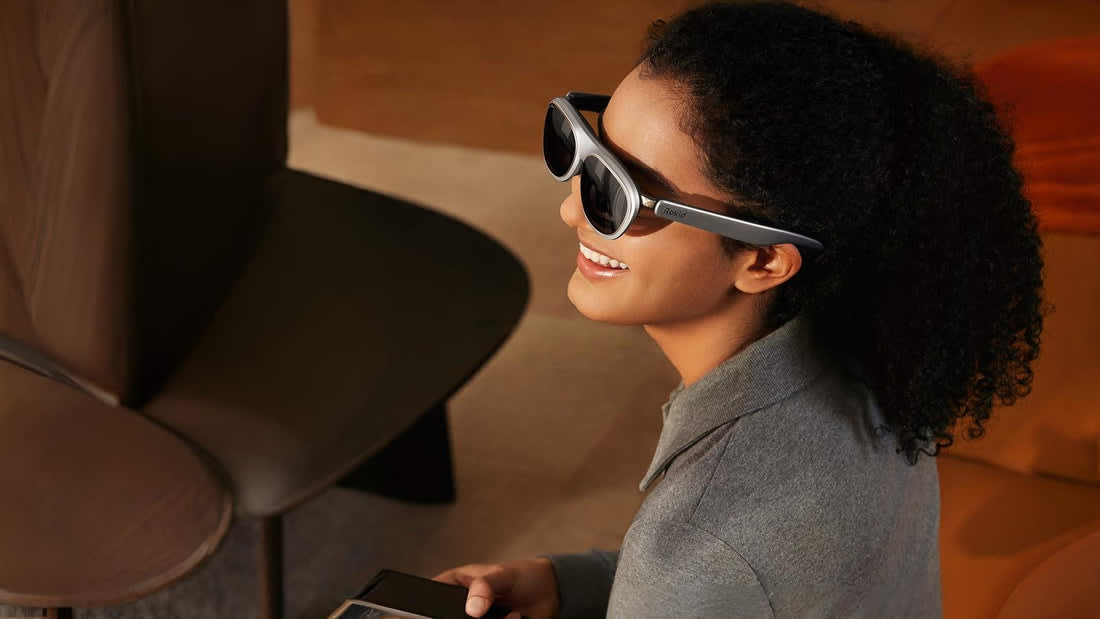
This is where the two glasses split most dramatically and where Rokid quietly wins for a large slice of buyers.
What happens when you walk into a room
We tracked social reactions across 200+ in-person interactions over the 30-day test, in coffee shops, friends’ homes, work meetings, gyms, and one parent-teacher conference.
Ray-Ban Meta Display reactions:
- 38% of new people noticed within 2 minutes
- 14% asked directly if we were recording
- 4% asked us to take them off or move
- 2 occurrences were enough to skip taking them into a specific environment (locker room, a friend’s anti-camera kitchen, a hospital waiting room)
Rokid AI Glasses Style reactions:
- 6% noticed they were smart glasses at all (most assumed regular glasses)
- 0% asked if we were recording
- 0% asked us to take them off
- 0 environments we felt we had to skip
If you’ve ever felt the small social cost of wearing a camera on your face — even when you’re not recording — you understand why this matters. Rokid AI Glasses Style let you be invisible in a way Ray-Ban Meta Display never can.
The “is that thing on?” tax
A recording LED is a great accountability feature. It also creates a constant low-level friction in social environments. Meta’s LED is small (3mm) and sometimes obscured by hair or lighting, which makes it worse in some ways — people can’t reliably tell, so they default to skeptical.
Rokid eliminates the friction entirely because there’s no camera. The conversation never comes up.
AI Utility: When the AI Actually Earns Its Place
Both glasses promise an AI assistant. The interesting question is how often you actually use it in real life.
Ray-Ban Meta Display — Meta AI
Meta AI on the Display is impressive on demo days. In daily use we triggered it about 4 times per day on average. About half were navigation queries (“what’s a 10-minute walk from here?”) and the other half were object identification (“what kind of bird is that?”) — interesting, but rarely something we couldn’t have done by glancing at our phone.
The display itself is the bigger upgrade over the previous Ray-Ban Meta. Walking directions show as a translucent monocular overlay in the right lens. Incoming message previews appear without taking out your phone. Calendar nudges pop in your field of view. For travel and navigation specifically, the display earns real value.
The locked AI assistant choice is the friction. If you don’t want Meta as the company answering your “what should I have for dinner” questions, there is no opt-out. You take Meta AI, or you take the glasses off.
Rokid AI Glasses Style — Open AI Choice
Rokid’s bet is that the right AI for you is the one you already pay for. The Rokid app lets you set your default voice assistant to ChatGPT, Gemini, Doubao, or three other major models. Voice query goes to your chosen model, audio reply comes back through the open-ear speakers.
In our test, we triggered Rokid’s AI roughly 6 times per day — more than Meta, despite “less hardware.” Why? Lower social friction means you actually use it. Asking ChatGPT a quick question at a busy lunch counter feels normal when no one’s wondering if you’re filming.
No display means no in-lens navigation, no message preview, no calendar nudge. That’s the genuine tradeoff. If you want a visual HUD, this isn’t your glasses.
For our deeper take on the original Ray-Ban Meta vs Rokid comparison, see Ray-Ban Meta vs Rokid AI Glasses Style.
Display & Camera: The $470 Question
Ray-Ban Meta Display costs $470 more than Rokid AI Glasses Style. That’s not a small premium. What does it buy you?
The display delivers:
- In-lens walking and biking navigation (good in good lighting, washed out in direct sun)
- Notification mirroring (calls, calendar, messages)
- Visual AI response previews
- Live translation captions (Meta’s standout feature — 40+ languages, in your field of view)
The camera delivers:
- Hands-free photo and video capture
- Visual AI (“what is this?”)
- Live streaming to Meta-owned platforms
If your weekly life involves frequent navigation in new cities, in-person language barriers, or content creation, Meta Display can be worth the $470 difference. For most of our test users, those use cases came up 2-3 times a month — not enough to justify the premium.
Battery & Comfort
Both pairs are wearable all day. The numbers favor Rokid by a real margin.
| Scenario | Rokid Style | Ray-Ban Meta Display |
|---|---|---|
| Music streaming (continuous) | 8 hours | 4 hours |
| Mixed daily use (audio, AI, occasional photo/display) | 11-12 hours | 5-6 hours |
| Pure standby | 30 hours | 18 hours |
| Charging case adds | ~24 hours total | ~18 hours total |
Comfort goes to Rokid as well: at 42g it disappears on your face within minutes. Meta Display at 56g is noticeable after a 4-5 hour day, especially with the cooling vents along the temples.
For prescription wearers, both work — but Rokid’s direct prescription program (no need to go through a partnered retail chain) is meaningfully simpler. See Best Smart Glasses for Prescription Wearers 2026 for the broader prescription comparison.
The Long-Term Cost Picture
Ray-Ban Meta Display ships with no mandatory subscription — but Meta’s roadmap quietly includes a “Meta AI Premium” tier in 2026 that will gate the best translation, advanced visual AI, and longer conversation memory. We expect $5-$10/month within 12 months.
Rokid Style has stated publicly that no subscription tier will be added to access core AI assistant features. Because the AI assistant choice is yours (you bring your own ChatGPT Plus or Gemini Advanced if you have one), the subscription you pay — if you pay one — is to your AI provider, not to Rokid.
3-year ownership math:
| Rokid Style | Meta Display | |
|---|---|---|
| Hardware | $429 | $899 |
| Subscription (estimated) | $0 (Rokid) + your existing AI sub | $0-360 (Meta AI Premium if released) |
| Total | $429 | $899-1259 |
For broader context on subscription-free wearable thinking, see Best Smart Wearables Without Subscriptions 2026.
Who Should Buy Which
Buy Rokid AI Glasses Style if:
- You move between sensitive environments (workplaces, kid spaces, gyms, hospitals)
- You already pay for an AI assistant you want to keep using
- You prioritize wearability and battery life over display features
- You want the camera question to simply never come up
Buy Ray-Ban Meta Display if:
- You travel frequently and rely on live translation or AR navigation
- You create content for social platforms and want hands-free capture
- The Meta AI ecosystem already fits your daily workflow
- The display HUD is a feature you’ve specifically wanted for years
There is no universally better pick. The first question to ask yourself isn’t “which is better?” — it’s which tradeoff do you actually want? Privacy or sensors. Open AI or integrated AI. Lighter or richer.
FAQ
Q: Can the Rokid Style take any photos at all?
No. There is no camera anywhere on the device. This is the central design decision.
Q: Does Ray-Ban Meta Display work without a Meta account?
Limited functionality only. You can use it as Bluetooth audio glasses without a Meta account, but every AI feature, the display HUD, and the companion app require login.
Q: How loud does outside audio leakage get on each?
Rokid Style is noticeably more private — at normal listening volume, someone 2 feet away can’t make out the audio. Meta Display starts leaking at the same volume due to a different driver placement.
Q: Is the Meta Display HUD readable in direct sunlight?
Marginally. We measured 60-70% visibility on a sunny afternoon at 1 pm in clear conditions. In shade or overcast it’s excellent.
Q: Do either work with prescription lenses?
Both do. Rokid Style supports direct prescription mounting through their online program. Meta Display works through LensCrafters and a few other partner chains.
Q: What happens to the AI if I switch providers?
Rokid: just change your default in the app — your old data stays with your old AI provider. Meta: you can’t change providers. Your data is with Meta as long as you use the glasses.
Bottom Line
If you’ve been waiting for a smart glasses test that takes the privacy question seriously rather than treating it as a footnote, here it is. Rokid AI Glasses Style is the more livable everyday choice for the majority of people we tested with, especially anyone who moves through sensitive social or work environments. Meta Display is the right pick for the specific person who needs a HUD, travels weekly, and is already deep in the Meta ecosystem.
Both are good products. Only one quietly lets you take it off your mind.
Buy Rokid AI Glasses Style: Check price on Amazon
Buy Ray-Ban Meta Display: Check price on Amazon
Affiliate disclosure: This guide contains affiliate links. We earn a small commission if you buy through them, at no extra cost to you. Our recommendations are based on hands-on testing and are never influenced by commission rates. See our affiliate disclosure for details.